Trinh Nguyen
Doctor of Philosophy in Library, Archival and Information Studies (PhD)
Exploring information governance in sustainable decentralized projects
Review details about the recently announced changes to study and work permits that apply to master’s and doctoral degree students. Read more
UBC iSchool’s Ph.D. program is a four-year funded program that combines coursework with independent study and research. Students have access to faculty members and advisors and benefit from unique opportunities at a research-intensive university. The Ph.D. program is designed to provide advanced education for outstanding students who have already obtained a Master of Archival Studies (MAS) degree, a Master of Library and Information Studies (MLIS) or an equivalent related degree.
We are home to a community of researchers actively engaged in investigating questions of vital importance to society in the age of information. At the broadest level, we are concerned with recorded artifacts of human experience: their creation, collection, organization, preservation, and use. Increasingly, these artifacts - books, documents, images, data, etc.- are created and/or preserved in digital formats that can be widely disseminated and used. Our collective work aims to ensure that this legacy of human experience, housed in both traditional and newer digital forms, is preserved, shared and explored, so that individuals and communities can continue to draw upon it to deepen their understanding of themselves and their communities and make new discoveries about our world.
The Faculty of Graduate and Postdoctoral Studies establishes the minimum admission requirements common to all applicants, usually a minimum overall average in the B+ range (76% at UBC). The graduate program that you are applying to may have additional requirements. Please review the specific requirements for applicants with credentials from institutions in:
Each program may set higher academic minimum requirements. Please review the program website carefully to understand the program requirements. Meeting the minimum requirements does not guarantee admission as it is a competitive process.
Applicants from a university outside Canada in which English is not the primary language of instruction must provide results of an English language proficiency examination as part of their application. Tests must have been taken within the last 24 months at the time of submission of your application.
Minimum requirements for the two most common English language proficiency tests to apply to this program are listed below:
Overall score requirement: 100
Reading
22
Writing
21
Speaking
21
Listening
22
Overall score requirement: 7.5
Reading
7.0
Writing
7.0
Speaking
7.0
Listening
7.0
Some programs require additional test scores such as the Graduate Record Examination (GRE) or the Graduate Management Test (GMAT). The requirements for this program are:
The GRE is not required.
All applicants have to submit transcripts from all past post-secondary study. Document submission requirements depend on whether your institution of study is within Canada or outside of Canada.
Many programs require a statement of interest, sometimes called a "statement of intent", "description of research interests" or something similar.
Students in research-based programs usually require a faculty member to function as their thesis supervisor. Please follow the instructions provided by each program whether applicants should contact faculty members.
Permanent Residents of Canada must provide a clear photocopy of both sides of the Permanent Resident card.
All applicants must complete an online application form and pay the application fee to be considered for admission to UBC.
Human-computer Interaction, Information Interaction and Design, Cultural Heritage, Documentation, Records and Information Management, History of the Book, Natural Language Processing, Deep Learning, Knowledge Organization, Digital Archives/Media and Social media.
PhD students are provided a lab space specifically for work and research in the school. The iSchool has an additional computer lab and bookable spaces with high-tech equipment for use in usability studies, conducting user research and analysis and more.
| Fees | Canadian Citizen / Permanent Resident / Refugee / Diplomat | International |
|---|---|---|
| Application Fee | $118.50 | $168.25 |
| Tuition * | ||
| Installments per year | 3 | 3 |
| Tuition per installment | $1,912.84 | $3,360.55 |
| Tuition per year (plus annual increase, usually 2%-5%) | $5,738.52 | $10,081.65 |
| Int. Tuition Award (ITA) per year (if eligible) | $3,200.00 (-) | |
| Other Fees and Costs | ||
| Supplementary fees (once) | $244.25 Mandatory program fee, student society fee | |
| Student Fees (yearly) | $1,169.35 (approx.) | |
| Costs of living | Estimate your costs of living with our interactive tool in order to start developing a financial plan for your graduate studies. | |
Applicants to UBC have access to a variety of funding options, including merit-based (i.e. based on your academic performance) and need-based (i.e. based on your financial situation) opportunities.
This results in a net balance (any funding provided to the student minus tuition and fees) mean of $33,772 and median of $33,178.
All applicants are encouraged to review the awards listing to identify potential opportunities to fund their graduate education. The database lists merit-based scholarships and awards and allows for filtering by various criteria, such as domestic vs. international or degree level.
Many professors are able to provide Research Assistantships (GRA) from their research grants to support full-time graduate students studying under their supervision. The duties constitute part of the student's graduate degree requirements. A Graduate Research Assistantship is considered a form of fellowship for a period of graduate study and is therefore not covered by a collective agreement. Stipends vary widely, and are dependent on the field of study and the type of research grant from which the assistantship is being funded.
Graduate programs may have Teaching Assistantships available for registered full-time graduate students. Full teaching assistantships involve 12 hours work per week in preparation, lecturing, or laboratory instruction although many graduate programs offer partial TA appointments at less than 12 hours per week. Teaching assistantship rates are set by collective bargaining between the University and the Teaching Assistants' Union.
Academic Assistantships are employment opportunities to perform work that is relevant to the university or to an individual faculty member, but not to support the student’s graduate research and thesis. Wages are considered regular earnings and when paid monthly, include vacation pay.
Canadian and US applicants may qualify for governmental loans to finance their studies. Please review eligibility and types of loans.
All students may be able to access private sector or bank loans.
UBC has working agreements with MPower Financing - an organization providing international students with no-cosigner, no-collateral education loans to study in Canada - and Windmill Microlending - an organization providing loans to skilled immigrants.
Many foreign governments provide support to their citizens in pursuing education abroad. International applicants should check the various governmental resources in their home country, such as the Department of Education, for available scholarships.
The possibility to pursue work to supplement income may depend on the demands the program has on students. It should be carefully weighed if work leads to prolonged program durations or whether work placements can be meaningfully embedded into a program.
International students enrolled as full-time students with a valid study permit can work on campus for unlimited hours and work off-campus for no more than 24 hours a week during academic sessions.
A good starting point to explore student jobs is the UBC Work Learn program or a Co-Op placement.
Students with taxable income in Canada may be able to claim federal or provincial tax credits.
Canadian residents with RRSP accounts may be able to use the Lifelong Learning Plan (LLP) which allows students to withdraw amounts from their registered retirement savings plan (RRSPs) to finance full-time training or education for themselves or their partner.
Please review Filing taxes in Canada on the student services website for more information.
Applicants have access to the cost estimator to develop a financial plan that takes into account various income sources and expenses.
9 students graduated between 2005 and 2013. Of these, career information was obtained for 7 alumni (based on research conducted between Feb-May 2016):
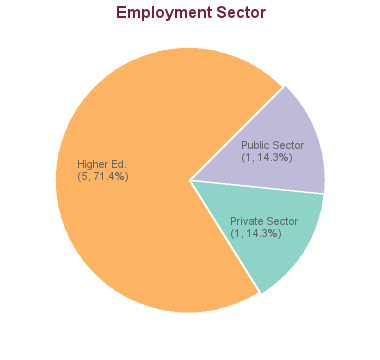
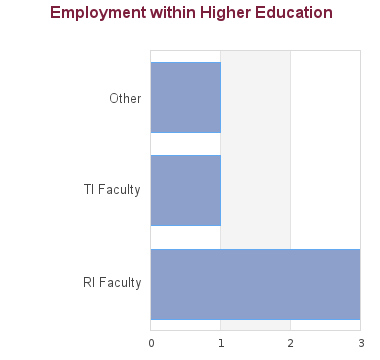
UBC's Faculty of Graduate and Postdoctoral Studies prepared an in-depth report tracking outcomes for more than 3,800 PhD students who graduated between 2005-13. Using a combination of survey and internet searches, information was obtained for 91% of these graduates. This approach, and the ability to link the outcomes to student data, allowed a more comprehensive and richer analysis of student outcomes than most studies of this kind. The data is publicly available on their website and features outcome comparisons by faculty and subject area.
These statistics show data for the Doctor of Philosophy in Library, Archival and Information Studies (PhD). Data are separated for each degree program combination. You may view data for other degree options in the respective program profile.
| 2024 | 2023 | 2022 | 2021 | 2020 | |
|---|---|---|---|---|---|
| Applications | 31 | 21 | 32 | 32 | 36 |
| Offers | 6 | 3 | 6 | 5 | 4 |
| New Registrations | 5 | 3 | 5 | 3 | 3 |
| Total Enrolment | 24 | 22 | 24 | 22 | 20 |
Students in research-based programs usually require a faculty member to function as their thesis supervisor. Please follow the instructions provided by each program whether applicants should contact faculty members.
These videos contain some general advice from faculty across UBC on finding and reaching out to a supervisor. They are not program specific.
This list shows faculty members with full supervisory privileges who are affiliated with this program. It is not a comprehensive list of all potential supervisors as faculty from other programs or faculty members without full supervisory privileges can request approvals to supervise graduate students in this program.
| Year | Citation |
|---|---|
| 2024 | Dr. Zhang developed machine learning systems that enhanced the understanding of semantic meanings in language, capturing the nuances of human reactions, communications, and intentions beyond words. He proposed novel language representation learning methods that utilize pragmatic signals to more effectively learn human language, leveraging vast amounts of social media data. |
| 2024 | Why volunteer to help others fix items that are easy to replace? Dr. Kaczmarek explored the motivations and aspirations of volunteers at community repair events, as well as the impact of COVID-19 on their activities. Her research reveals the social and material value of repair through the stories of those involved. |
| 2024 | Dr. Triponez investigated the archival preservation of independent music production by interviewing music creators. He found that social and technological disruption, evolving creative practices, and the abundance of archival material pose preservation problems that result in an ongoing loss of documentary cultural heritage. |
| 2024 | Dr. Payne created a novel auto-classification process that leverages a record's context, not just its content, to improve classification accuracy. His research in artificial intelligence, context, and computational archival science, will help organizations around the world more effectively classify, organize and activate data and information. |
| 2023 | There are many unsolvable debates in the world. How do we use the Internet to make sense of them? Dr. Novin researched how biases on the Internet influenced student inquiries, search strategies, and decisions. He documented the cognitive methods participants used to counter biases. This will help educators with teaching critical thinking skills. |
| 2023 | Dr. Shankar explored practices with immigration data in Canada. Findings emphasize difference, interdependence, and the need for negotiation of responsibilities across groups working with immigration data. Her work offers implications to governmental and non-governmental actors for ethical decision making and the use of communities' data with care. |
| 2023 | Dr. Tulloch examined the way young people used Internet memes to process and communicate information in their daily lives. Her research highlights the importance of humour to their memetic storytelling and the implications it holds for digital citizenship education. Laughter,she argues, helps people negotiate the different values memes instantiate. |
| 2022 | Dr. Cole examined working adults' sense of self-efficacy when learning using web search engines. They constructed a scale of self-efficacy and applied mixed methods to identify factors that contribute to User Experience professionals' sense of confidence while learning using search. |
| 2022 | Dr. Figueiredo studied how context and agency affect Brazilian school children's information searching strategies to complete homework. She found that these strategies depend on school and home resources, and interpersonal assistance. Her analysis of information searching strategies provides recommendations for designing youth digital applications. |
| 2022 | Dr. Evans examined records retention and disposition in Canadian organizations. She found that by aligning information governance efforts and leveraging digital technologies, records managers, archivists, and technologists could significantly decrease the climate impacts of information and communication technology on the environment. |
Library, Archival and Information Studies provides an interdisciplinary, high-demand educational experience in which students gain rich expertise suited to hybrid library/archives environments and cultural institutions. Area of study includes First Nations Curriculum Concentrations; Data services; Librarianship; Community and culture; Information interaction and design; Information sources and services; Digital resource management; Information analysis and management; Archives and preservation; Records management; information policy.
Departments/Programs may update graduate degree program details through the Faculty & Staff portal. To update contact details for application inquiries, please use this form.